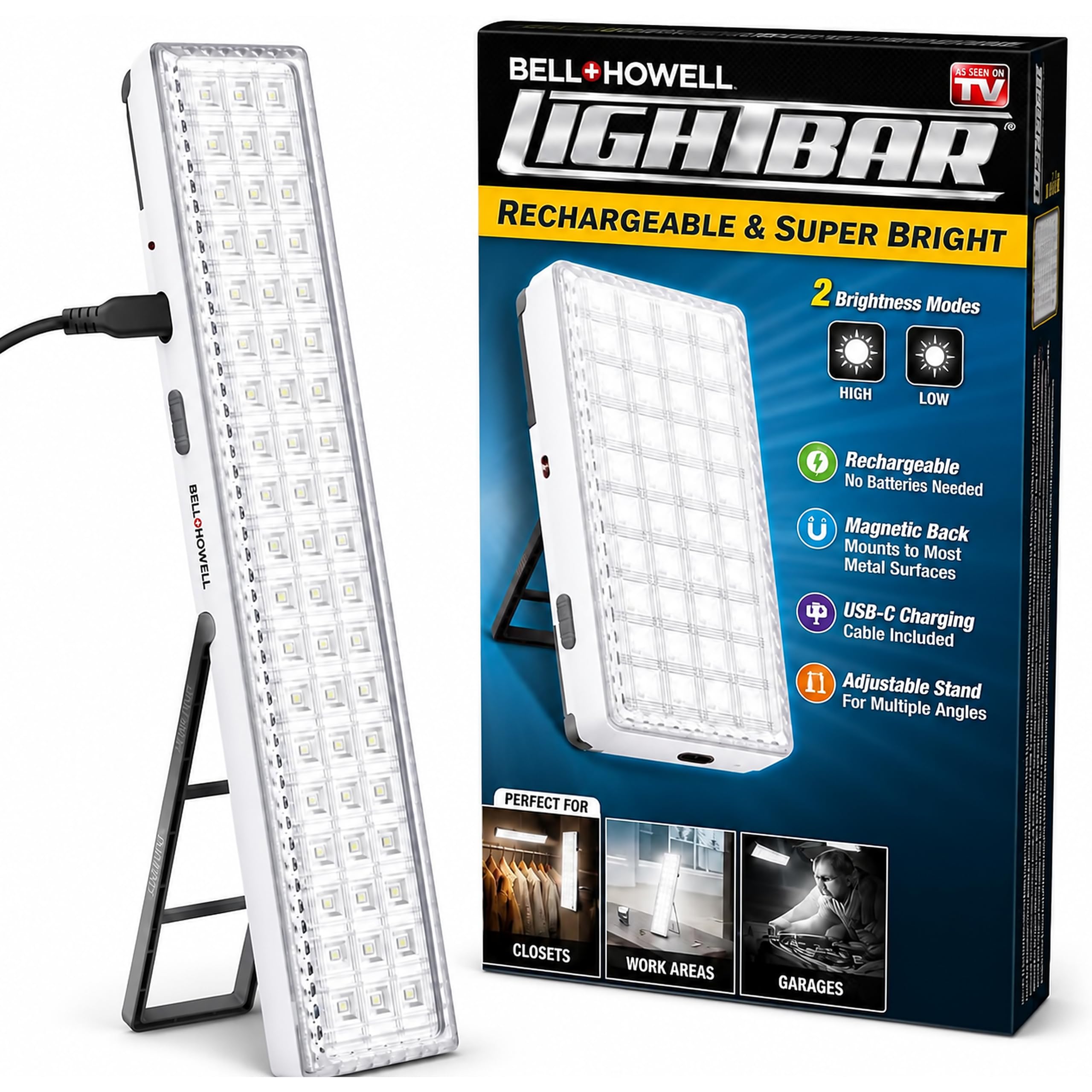
The BELL+HOWELL Portable Light Bar review centers on a rechargeable backup light with an outage sensor, two brightness settings, and several ways to position it.
It is designed for indoor use and dry outdoor settings, with the convenience of switching on automatically when household power fails.
Portable Light Bar Review Summary
The quick verdict
3,000+ ratings
Read Amazon ReviewsBELL+HOWELL Portable Light Bar
A practical choice for households wanting a rechargeable light that can turn on automatically during an outage and move where needed.
- Cordless 16.5-inch light bar with 60 built-in LEDs.
- Up to 720 lumens, with two brightness modes.
- Outage sensor designed to turn the light on when household power fails while plugged in with the sensor active.
- Fold-out stand and hanger offer tabletop or suspended placement.

Pros
- Automatic outage lighting can reduce the need to find a separate flashlight when power fails.
- Two brightness modes support both stronger illumination and a lower, battery-conscious setting.
Consider before buying
- The roughly 24-hour initial charge means it needs advance preparation before first use.
- Battery runtime depends on the selected mode, and the brightest setting drains power faster.
Read the full review summary
This 16.5-inch light bar combines 60 LEDs with a maximum output of up to 720 lumens.
Its outage sensor is the defining feature: leave the unit plugged into a wall outlet with the sensor active, and it is designed to light when power cuts out.
A push button controls two brightness modes, while a fold-out stand and hanger support tabletop placement or hanging.
The design suits households that want an always-connected backup for a kitchen, basement, garage, or other utility space, along with a portable light for camping or vehicle trouble in dry conditions.
It needs an initial charge of about 24 hours and periodic recharging during storage.
Because runtime varies by brightness setting and the light is not waterproof, it works best when buyers plan its placement and upkeep around those limits.
The buying factors
Portable Light Bar Scorecard
Editorial scores reflect listed features and buyer fit; they are not laboratory measurements or customer ratings.
Outage readiness
The sensor can switch the light on automatically during a power failure when the bar is plugged in and the sensor is active.
Lighting flexibility
Two brightness modes let users choose between maximum output and a lower setting intended to extend battery use.
Placement options
A fold-out stand, hanger, and compact bar shape support several useful positions around home or camp.
Portability
The 16.5-inch cordless design can move between rooms or travel with camping and roadside gear.
Ease of operation
A push-button control keeps brightness selection straightforward.
Outdoor suitability
It can be used outdoors in dry conditions, but its non-waterproof design calls for shelter from moisture.
Key Features and Specifications of Portable Light Bar
- Cordless 16.5-inch light bar with 60 built-in LEDs.
- Up to 720 lumens, with two brightness modes.
- Outage sensor designed to turn the light on when household power fails while plugged in with the sensor active.
- Fold-out stand and hanger offer tabletop or suspended placement.
- Rechargeable battery powered, with an AC charging adapter included.
- Requires about 24 hours of charging before first use; recharge every few months when stored.
- Intended for indoor settings and dry outdoor use; it is not waterproof.
Pros and Cons of Portable Light Bar
Pros
- Automatic outage lighting can reduce the need to find a separate flashlight when power fails.
- Two brightness modes support both stronger illumination and a lower, battery-conscious setting.
- The stand and hanger make it adaptable to work surfaces, shelves, and hooks.
- Its portable form can serve at home, on camping trips, or during roadside situations in dry weather.
Consider before buying
- The roughly 24-hour initial charge means it needs advance preparation before first use.
- Battery runtime depends on the selected mode, and the brightest setting drains power faster.
- It is not waterproof, so outdoor placement needs protection from rain and damp conditions.
- Stored units need periodic recharging every few months to stay ready.
Who Should Buy Portable Light Bar?
Good fit
Consider this light bar if you want a backup that can remain plugged into a convenient outlet and illuminate automatically during a power interruption.
That arrangement is most useful in a room where the bar can remain accessible and where the sensor can stay active.
It also fits buyers looking for a portable utility light with more placement flexibility than a handheld flashlight.
The stand and hanger make it useful around a workbench, shelf, tent, or other dry spot, and the lower brightness mode offers a way to conserve battery when full output is unnecessary.
Who should skip it
Choose another solution if you need a light that can be left exposed to rain, used in wet locations, or relied on outdoors without shelter. This model is specified for dry conditions and is not waterproof.
It may also be a poor fit if you need a backup that requires no charging routine.
Plan for the initial charge and periodic recharging during storage, and check that the outlet location suits the way you expect to use the outage sensor.
How the Portable Light Bar Fits Home Backup Needs
Automatic light when power fails
The outage sensor is the most distinctive part of the design.
Keeping the bar plugged in with the sensor active is intended to make it light automatically when household power is interrupted, which can be helpful in a room where darkness would make finding a flashlight difficult.
Buyers should choose an outlet and location that make sense for the area they want illuminated.
Brightness and battery choices
The high mode reaches up to 720 lumens, while the lower mode provides softer light and is intended to stretch battery use.
That gives the user a practical choice between maximum output and longer use, though the available runtime is not specified and will vary with the selected mode.
For extended outages, the lower setting may be the more conservative choice when it provides enough light for the task.
Positioning around home or camp
A fold-out stand allows the bar to rest on a table or shelf, while the hanger supports suspended placement.
These options can make it easier to direct light toward a work area or place it where a handheld light would be inconvenient.
Its portability also suits dry camping or roadside use, provided the setup protects it from moisture.
Keeping the backup ready
The unit needs about 24 hours of charging before its first use, and storage calls for recharging every few months. That upkeep is part of the tradeoff for a rechargeable light kept ready for occasional outages.
A periodic reminder can help ensure the bar has been charged before the next time it is needed.
Alternatives to Portable Light Bar
No alternative model is recommended here. Compare the design and features that matter to your routine before choosing another option.
Is Portable Light Bar Worth It?
The BELL+HOWELL Portable Light Bar is worth considering if you want a rechargeable household backup that can switch on automatically during a power cut, plus a portable light for dry utility and outdoor settings.
Its two brightness modes and stand-and-hanger placement give it useful flexibility.
Buy it if you can keep it plugged in where the outage sensor will help, and you are comfortable with the charging routine.
Skip it for exposed wet use or if you need a backup that asks for no maintenance.
Your review at a glance
3,000+ ratings
Read Amazon ReviewsBELL+HOWELL Portable Light Bar
A practical choice for households wanting a rechargeable light that can turn on automatically during an outage and move where needed.
- Cordless 16.5-inch light bar with 60 built-in LEDs.
- Up to 720 lumens, with two brightness modes.
- Outage sensor designed to turn the light on when household power fails while plugged in with the sensor active.
- Fold-out stand and hanger offer tabletop or suspended placement.